Document the interior report
Capture where and when water appears, whether it is active or intermittent, and whether the same area has been repaired before.
 COMMERCIAL
Active leaks, recurring repairs and visible roof concerns deserve a documented investigation and a practical next step.
Discuss your property ↗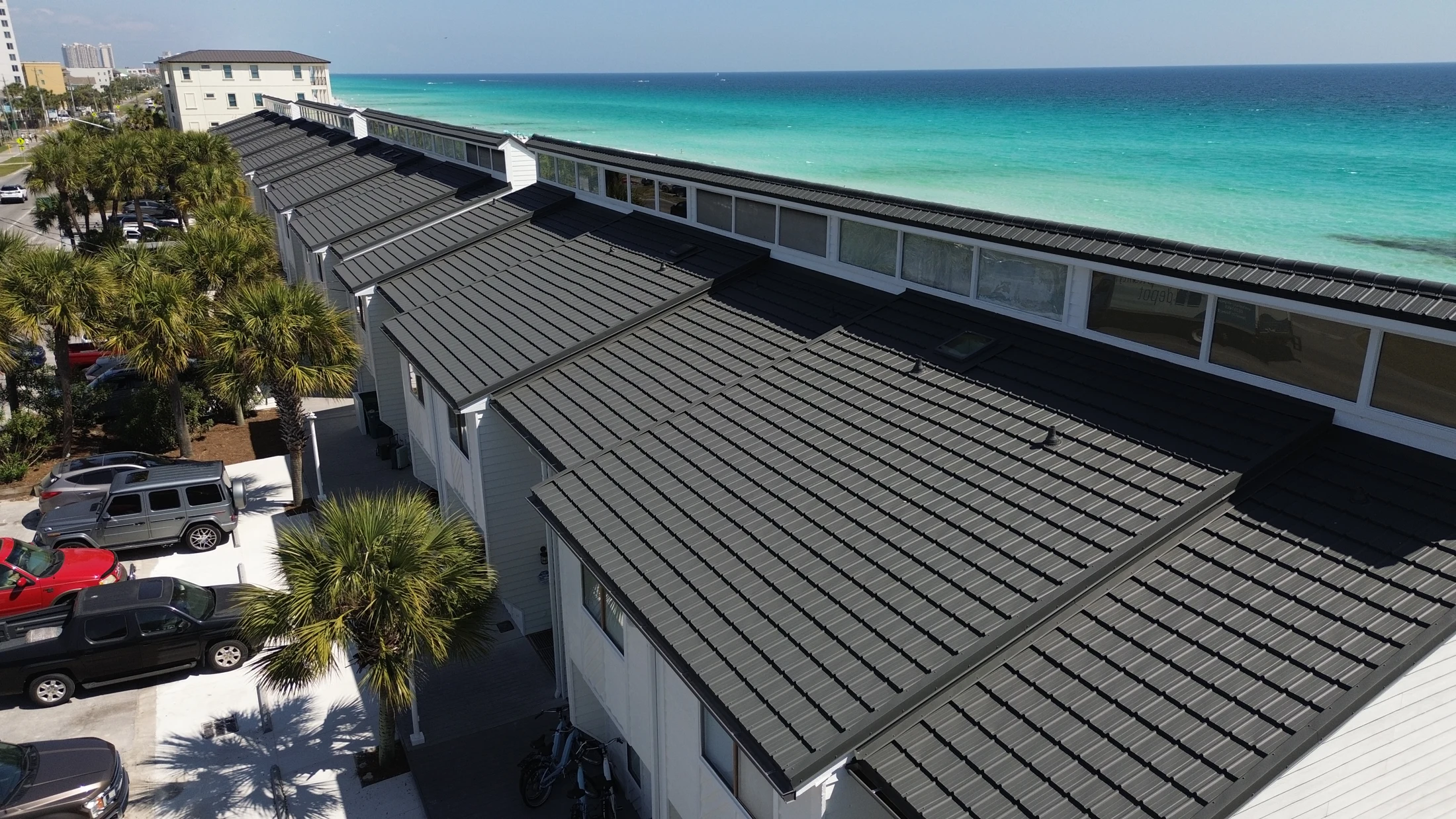
Active water inside? Protect people, inventory, equipment and electrical areas. Avoid unsafe roof access, then call the commercial team to discuss the conditions.
Water can travel before it becomes visible inside a building. The repair process should separate what is observed from what still needs confirmation instead of diagnosing an unseen roof from one interior stain.
For property teams coordinating access and operations along the Gulf Breeze corridor, see repair planning for Gulf Breeze commercial properties.
Capture where and when water appears, whether it is active or intermittent, and whether the same area has been repaired before.
Where authorized and safely accessible, review visible details around the relevant roof area and document observable conditions.
Photos can document visible conditions. Additional investigation may be needed before a source, repair scope, warranty issue, or system-wide conclusion can be confirmed.
Discuss targeted repair, maintenance, monitoring, additional investigation, or replacement planning based on the property and supported scope.
The exact inspection scope depends on the roof system, access, safety, weather, and property conditions. Where visible and relevant, the conversation may include membrane or metal conditions, seams, penetrations, flashing, perimeter details, drains, scuppers, gutters, curbs, and prior repair areas.
Roof access should be limited to authorized people following appropriate safety requirements.
Some properties need a defined localized repair. Others need a broader maintenance plan, additional investigation, or a replacement discussion because the same concern has been recurring. The goal is to match the scope to what the property actually supports—not automatically turn every leak into a reroof proposal.
When the evidence supports a focused scope, a targeted repair may be the practical next step.
A documented maintenance list can help owners prioritize several smaller visible items rather than waiting for more interior symptoms.
If repeated repairs or broader conditions suggest a larger capital decision deserves evaluation, move into documented replacement planning instead of assuming another patch is enough.
Not reliably. Water can travel before it becomes visible indoors. An interior symptom helps define the investigation area, but the source and repair scope should be supported by the property, roof conditions, access, and any additional investigation that may be needed.
No. A leak can lead to a targeted repair, maintenance, additional investigation, or replacement planning depending on the actual conditions. The goal is to match the next step to supported findings rather than assume the largest scope.
ECR's commercial materials support repair, preventative maintenance, TPO/PVC and low-slope roofing, and commercial metal roofing/retrofit conversations. The appropriate scope still depends on the actual property and roof system.
No. A form submission is a request for follow-up. For an active commercial issue, call Parker at 251-850-1002 so ECR can confirm the property, responsible contact, access, scope, and next step.
No. It should not be represented as engineering, destructive testing, structural analysis, code certification, insurance-coverage determination, or a warranty inspection.
Start with a complimentary Commercial Roof Asset Assessment. Tell us about the property and your priorities. We’ll follow up to discuss the next step.
Access, scope and scheduling are confirmed after your request is reviewed.